Decision Literacy
How to think clearly, evaluate choices, and understand consequences.
Free and open educational curriculum
A free, open curriculum that teaches ages 8–12 how emotions and social systems actually work.
18 weeks of hands-on, discussion-driven lessons — typically taught in three short sessions per week, each about 20 to 30 minutes — designed for classrooms, homeschool families, after-school clubs, and any adult who wants to help kids move from emotional reactivity to intentional, systems-based thinking about themselves and others.
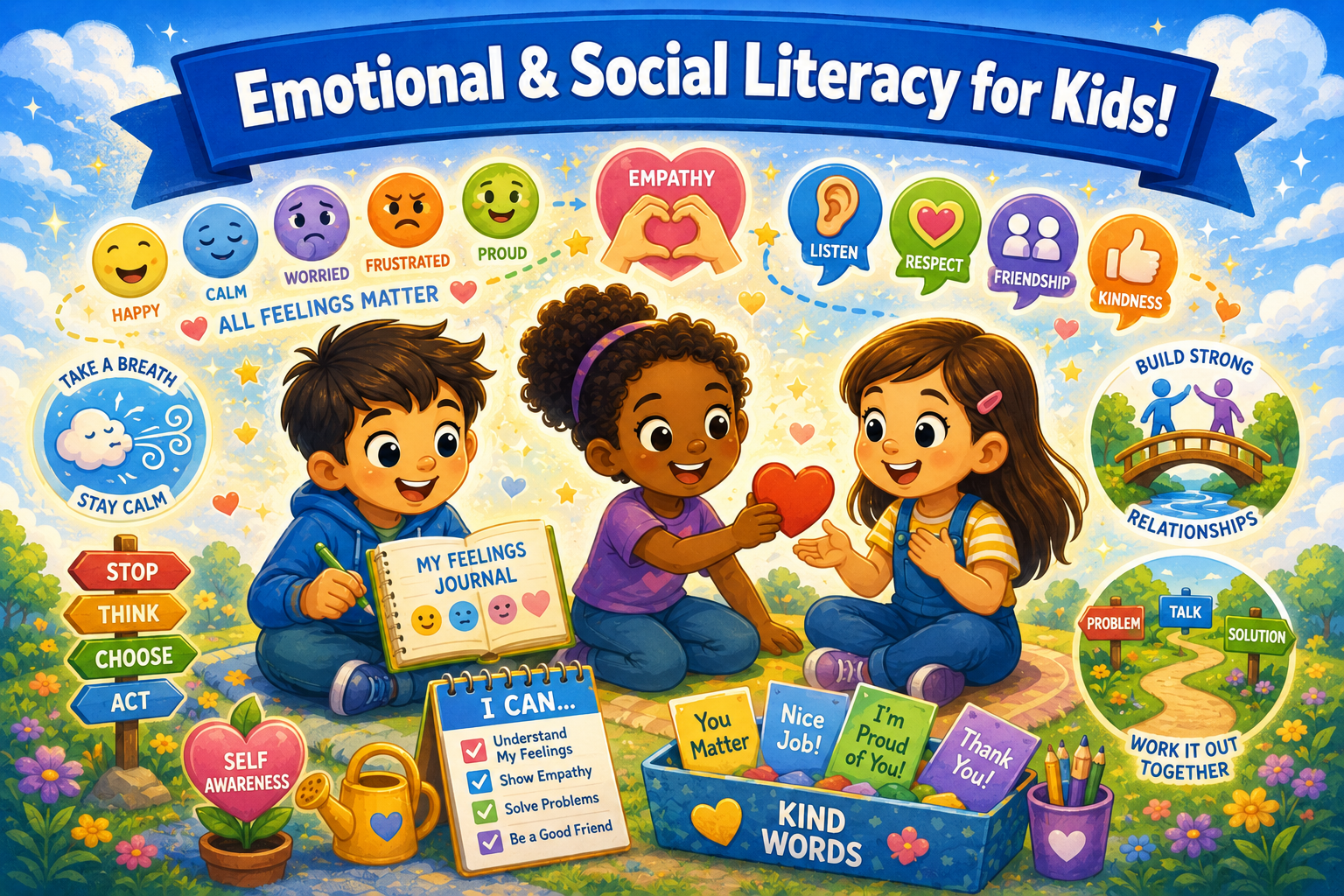
Emotional & Social Literacy for Kids is an 18-week curriculum for ages 8–12, built for classroom teachers, homeschool families, caregivers, and after-school leaders. Students move from understanding their own internal signals to engineering their social interfaces — learning how emotions work, how trust is built, and how to resolve conflict as a diagnostic problem across three short sessions per week.
This curriculum is part of Literacy for Kids, a collection of open-source curricula designed to help children ages 8–12 understand the systems that shape the modern world.
How to think clearly, evaluate choices, and understand consequences.
How computers work and how to use technology responsibly.
How to find, interpret, and evaluate information.
How money and financial systems affect everyday life.
How societies organize themselves and how citizens shape communities.
How emotions, cognition, and social systems shape behavior and relationships.
How laws are built, how contracts work, and how disputes get resolved.
How planetary systems work and how human activity interfaces with them.
How the human body operates as an integrated system of feedback loops.
The curriculum is organized around mental models that help students transition from being driven by emotional reactivity to intentionally debugging their internal states and navigating social architectures.
Students learn that fear, anger, and anxiety are biological data packets — information to read, not directives to obey.
Students learn to recognize when the brain forces a hard context-switch and how to pause and clear the buffer before responding.
Every interaction is a deposit or a withdrawal. Students learn to manage their trust ledger intentionally.
Friction rarely stems from malice — it is usually a mismatch in goals or asymmetric information. Students learn to diagnose, not attack.
Every signal sent creates ripples. Students analyze communication by how it is decoded by the receiving hardware, not just their own intent.
The learning progression moves from internal telemetry and signal debugging through trust networks and game theory, culminating in a real-world protocol design project.
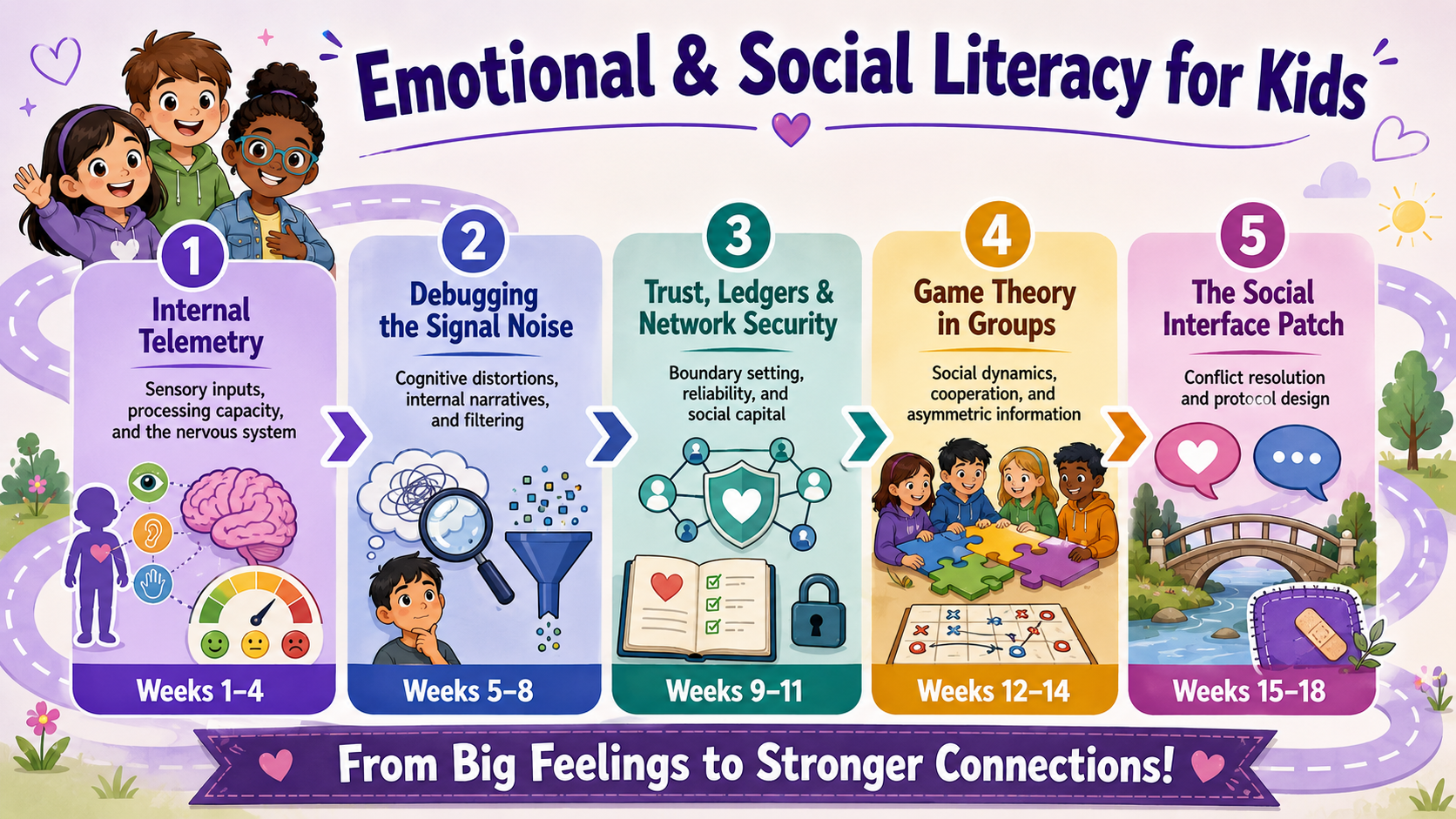
Weeks 1–4
Sensory inputs, processing capacity, and the nervous system
Weeks 5–8
Cognitive distortions, internal narratives, and filtering
Weeks 9–11
Boundary setting, reliability, and social capital
Weeks 12–14
Social dynamics, cooperation, and asymmetric information
Weeks 15–18
Conflict resolution and protocol design
Begin with the Welcome page, then review the facilitator guides before Week 1. Sessions are designed as three short meetings per week, each about 20 to 30 minutes.
Found a mistake or have a suggestion? Open an issue on GitHub.